 CEDO Global
A town can host a growing industry while its residents still struggle to earn a reliable living. We would look for three things in any proposal to change that. Are there customers who buy throughout the year? How do residents get paid work and progress? Who has a lasting claim on the income?
We examined these questions using international statistics, English and Welsh settlement data, procurement records and projects on six continents. The examples below show where to look, what can go wrong and which decisions a town can take for itself.
TOURISM & PRODUCTIVITY
The quiet months tell us more about job security than the busiest weekend.
In nine EU coastal regions, more than half of 2024’s recorded tourist nights fell in July and August. In Croatia’s Adriatic region the share was 57.7%. The OECD supplies a different piece of the picture. From 1995 to 2025, real output per full-time-equivalent job grew 13% in global marine and coastal tourism, compared with 75% across the ocean economy.
Consider the hotel that could fill another August weekend and the electrician who could win a winter maintenance contract for several hotels. Both can benefit tourism. The second order could also keep a technician employed long enough to supervise an apprentice. Visitor nights measure demand for accommodation. They tell us little about who gets paid in February, and productivity estimates do not measure wages.
Decision. Before backing an event or a new attraction, compare it with a second source of demand. Ask employers for monthly paid hours, hourly pay and contract length. Track whether incumbent workers gain income in the three quietest months.
Eurostat · regional tourism nightsOECD · tourism productivity, figure 6.8
PLACE & LABOUR MARKETS
A seaside postcode is a poor guide to the right intervention.
In the 2021 Census, 68.7% of working-age residents in coastal built-up areas of England and Wales were in work, against 71.0% in non-coastal areas. CEDO’s calculation from the same ONS workbook finds a 15.1 percentage-point spread among the 18 large coastal settlements alone, from 60.7% in Swansea to 75.8% in Worthing. Southport was at 71.1% and Blackpool at 65.5%.
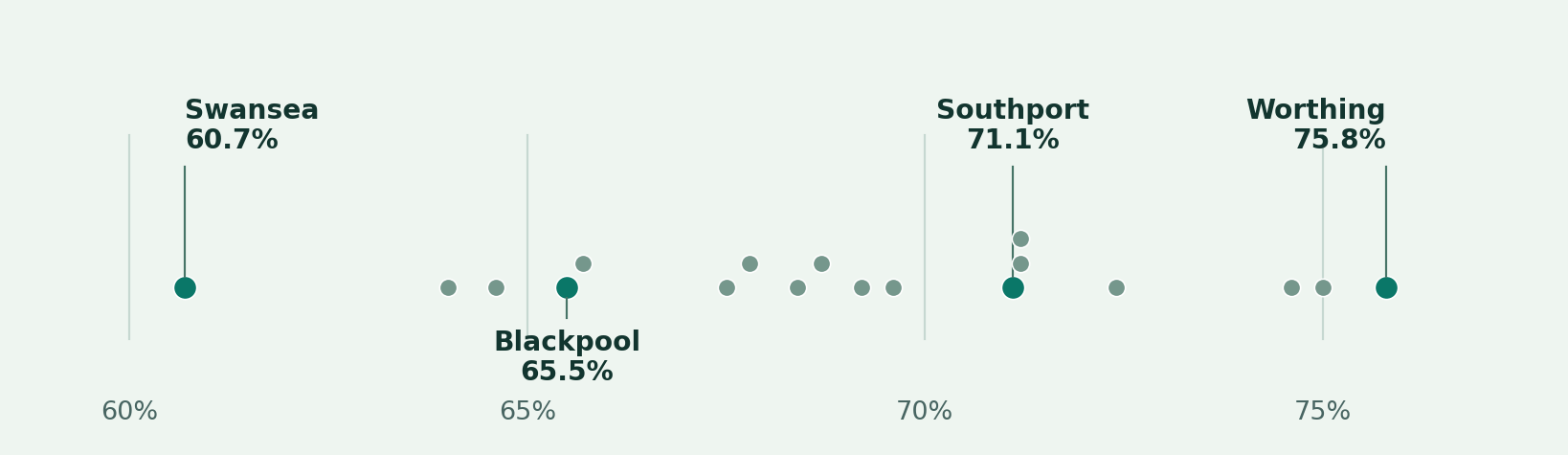 Each dot is one ONS large coastal built-up area. Overlapping values are stacked.
See all 18 settlement values
| Built-up area | In work (%) |
|---|---|
| Swansea | 60.7 |
| Hartlepool | 64.0 |
| Sunderland | 64.6 |
| Blackpool | 65.5 |
| Birkenhead | 65.7 |
| Grimsby | 67.5 |
| Wallasey | 67.8 |
| Bournemouth | 68.4 |
| Newport (Newport) | 68.7 |
| Hastings | 69.2 |
| Eastbourne | 69.6 |
| Southport | 71.1 |
| Chatham | 71.2 |
| Southend-on-Sea | 71.2 |
| Gillingham (Medway) | 72.4 |
| Weston-super-Mare | 74.6 |
| Poole | 75.0 |
| Worthing | 75.8 |
That range describes one pandemic-era Census day. Age, student populations, health and commuting all deserve investigation. A town where residents travel to good jobs faces a different choice from one where employers have vacancies that residents cannot reach or afford to take.
Decision. Choose a peer with a similar age profile, employer mix and travel-to-work geography. Then find a comparable place with better earnings or retention and investigate what it does differently. A higher employment figure is a starting point for a visit.
ONS · Census workbook, table 7dONS · geography and Census context
SKILLS & INDUSTRIAL DEMAND
The missing partner in a skills strategy may be a customer.
Sefton recorded 964 apprenticeship starts per 100,000 people in 2024/25, close to England’s 959. Yet in 2024 the borough had 0.60 workplace jobs per working-age resident, against 0.82 in the North West. Starts are recorded by home address. Jobs density counts jobs in the area, including those held by commuters. Together they raise a question about where residents can use their skills after training.
In the Basque Country, a vocational centre used a manufacturer’s components to learn a new 3D-printing process. Teachers tested materials, revised the parts and produced prototypes. The company brought an actual production problem. The college acquired expertise it could teach again. That is evidence of a working arrangement. Its impact on wages remains an open question.
Decision. Ask three employers what job they are already paying someone to do badly, slowly or at a distance. Build one paid assignment around the answer, with a supervisor, a route to the next job and a check on work and pay six months later.
DfE via ONS · starts by residenceONS Nomis · Sefton jobs densityTKgune · manufacturer and college project
TRADE & OWNERSHIP
Follow a sale until you know who keeps the margin.
On Pemba in Zanzibar, seaweed farmers described losing orders when sand contaminated crops as they dried on the ground. Better drying facilities helped buyers accept the crop. On Unguja, a women’s group took a further step into making products such as soap. FAO finds that women account for 62% of post-harvest fisheries and aquaculture workers where sex-disaggregated data are available. Counting only the harvest misses much of the workforce.
In Aotearoa New Zealand the question reaches further. The 1992 Māori fisheries settlement financed a 50% stake in Sealord and provided for 20% of quota for species newly entering the quota system. Rights secured through a Treaty settlement have their own legal and political history. Other places can ask who has an enforceable claim on future value.
Decision. Trace one local product or service from buyer invoice back to the people doing the work. Record payments, costs, unpaid hours, ownership of equipment or designs, and who can set terms next year. A processing investment earns its case when producers’ net returns improve after those costs.
UN / IFAD · Pemba and UngujaFAO · workers along the value chainTe Ohu Kaimoana · settlement history
CIVIC ASSETS & ENTERPRISE
A building can house an industry and help residents keep a stake in it.
Recife’s Porto Digital brings technology firms and training into a historic port district. Its operator reported 541 firms and 24,079 workers across its ecosystem in 2025. Those totals cannot tell us how many local residents gained jobs because of the district. Hastings Commons offers the complementary evidence. Its community land trust owns a third of its property development company, with a route to full ownership when the buildings cover their costs.
One case asks what firms can do together in a place. The other asks who controls the rents once people want to be there. A town that answers only the first risks paying to create a district its original tenants can no longer afford. A town that answers only the second may own a building without enough income to maintain it.
Decision. For a building such as Southport’s Assembly Rooms, first run a recurring paid use in borrowed space. Record repeat bookings, customer income and the cost of opening on an ordinary weekday. Pair that evidence with repair and insurance costs, affordable rents and explicit voting rights before taking on long-term liabilities.
Porto Digital · 2025 operator resultsHastings Commons · ownership and rents
ADAPTATION & LONG-TERM FINANCE
The work after construction belongs in the investment decision.
In Beira, Mozambique, restoring the Chiveve River and creating an urban park raised a practical question. Who would pay for upkeep? The design included rental income and a park management body. In Canada, 17 First Nations secured CAD 335 million in initial funding for Great Bear Sea stewardship and community economic development. That agreement establishes finance and decision-making authority. Its long-term effects on livelihoods will need to be measured.
Monitoring can also tell a community when to change course. In a pilot on Indonesia’s subsiding Demak coast, researchers measured erosion seaward of permeable structures and mixed results behind them over 2021–22. Even where sediment accumulated at the control site, the bed remained too low for mangrove colonisation. Counting structures installed would have missed the central finding.
Decision. Cost inspection, repairs and monitoring across the asset’s life. Identify the rights holders, who pays for repeat work and who can change or stop the intervention. Pair a livelihood measure with a physical outcome, such as paid maintenance days alongside measured changes in erosion.
World Bank · Beira management planCoast Funds · Great Bear Sea agreementDemak · monitored pilot and control site
A FIELD TEST FOR SOUTHPORT
Try selling a shoreline service before buying equipment.
Sefton’s regional monitoring programme already buys expertise. Its procurement report records £124,000 spent on terrestrial ecological mapping across the 2016–21 programme. The council also awarded a coastal remote-sensing framework in 2024. These records identify real buyers and incumbent suppliers. They establish neither an open contract nor an unmet need for a new entrant.
For an initial conversation, that puts shoreline monitoring ahead of independent-living technology and simulation training. All three could generate useful work. Monitoring already has a public purchasing history we can inspect. The quickest way to find out if Southport can add value is to ask the people who commission and deliver it.
- Days 1–30 · Find a gap in what buyers can get. Civic Coast could interview the programme team, incumbent survey firms and a second coastal authority. Ask for the last delayed, repeated or unusually costly job, the specification, what it cost and who could authorise a trial. Pay local technicians and learners for time spent shaping it.
- Days 31–60 · Quote for one job. A college and an experienced supplier could cost a supervised assignment such as checking a shoreline dataset against survey records. Include wages, travel, insurance, quality assurance and rework. Agree acceptance criteria, data rights and a price with the buyer before delivery.
- Days 61–90 · Test whether it travels. Deliver only against an agreed paid order. Ask the first buyer what would earn a repeat order and a second place whether it would buy to the same specification. Publish the price, paid hours and acceptance result where disclosure is agreed.
Decision at day 90. Expand only with accepted paid work, a credible repeat buyer or second buyer, and a price that covers supervision and fair pay. If demand is already well served, record that finding and move on. An existing supplier willing to host paid placements would be a useful result in its own right.
Sefton · ecological mapping procurementSefton · remote-sensing contract register
How to read the evidence
Prepared by the Coastal Economy Data Observatory, a Civic Coast initiative, on 26 November 2026. The six findings draw on selected cases, official statistics and a place comparison calculated from ONS Census 2021 table 7d. The comparison includes all 18 settlements classified by ONS as both large and coastal in England and Wales. The 15.1-point range is the highest published rate less the lowest. Coastal and non-coastal headline rates are ONS population aggregates.
OECD’s experimental ocean-industry estimates describe activities worldwide. Eurostat counts nights in tourist accommodation. Neither measures the whole economy of a coastal town. Southport figures refer to its built-up area. Sefton figures refer to the wider borough. Selected cases illustrate mechanisms and constraints. They cannot establish average impacts or guarantee results elsewhere. The Southport trial, proposed partners and scorecard are recommendations for testing.